
- Search
- Riyadh26 ° C


How Electric Toothbrushes Damage Your Gums — and How AirJet Engineered a Way Out
The Irony at the Heart of Oral Care
We buy electric toothbrushes to protect our teeth and gums. We choose them over manual brushes because the science says they clean better. And for the most part, that science is right — on flat, accessible tooth surfaces, powered brushes outperform manual brushing by a measurable margin. But buried beneath the marketing claims of "whiter teeth in one week" and "removes 5× more plaque" is an uncomfortable truth the industry has spent decades avoiding: the very mechanism that makes electric toothbrushes effective — high-frequency mechanical friction — is also what makes them dangerous to the soft tissue that holds your teeth in place.
Gum recession, once a condition associated primarily with aging and aggressive manual brushing, is now appearing in younger populations at rates that correlate closely with the mass adoption of high-frequency sonic toothbrushes. The connection is not accidental. It is a predictable consequence of a design philosophy that has prioritized ever-higher stroke counts over the biological tolerance of gingival tissue.
To understand why — and how RANVOO's AirJet technology represents a genuine departure from this trajectory — we need to examine what actually happens at the gum line when a traditional electric toothbrush is in use.
.png)
The Anatomy of a Micro-Trauma
Human gingival tissue — the gum collar surrounding each tooth — is composed of delicate squamous epithelium overlying a richly vascularized connective tissue bed. It is not designed to withstand sustained mechanical abrasion. When a toothbrush bristle strikes the gingival margin, three things happen in rapid succession: the epithelial barrier is compressed, sub-epithelial capillaries are momentarily occluded, and the junctional epithelium — the specialized tissue that seals the gum to the tooth surface — experiences shear stress.
Under normal conditions, with a soft manual brush and gentle technique, these micro-events are inconsequential. The tissue recovers between brushings, and no cumulative damage accrues. But introduce a brush head oscillating at 40,000, 50,000, or 62,000 strokes per minute — the frequencies commonly advertised by premium sonic toothbrushes — and the calculus changes entirely. At 40,000 strokes per minute, the gingival margin receives approximately 667 bristle impacts per second. Over a dentist-recommended two-minute brushing session, that is 80,000 individual mechanical events concentrated on tissue no more than two millimeters thick.
The body's inflammatory response is predictable: vasodilation, increased vascular permeability, leukocyte infiltration. Clinically, this manifests as the pink-tinged spit in the sink that millions of users have learned to accept as normal. It is not normal. It is a sign of active gingival trauma.
Over months and years, the cumulative effect of this daily micro-barrage is gingival recession — the slow, irreversible retreat of gum tissue away from the tooth crown, exposing the cementum-covered root surface beneath. Unlike enamel, cementum is soft, porous, and highly susceptible to both decay and sensitivity. Once gum tissue has receded, it does not grow back. The damage is permanent.
The Frequency Arms Race: Why Brushes Keep Getting More Aggressive
If higher frequencies damage gums, why do manufacturers keep pushing them higher? The answer lies in a fundamental limitation of the bristle-based cleaning model.
Conventional electric toothbrushes clean exclusively through contact: bristle tip meets tooth surface, friction dislodges plaque. This works on facial and lingual surfaces — the broad, flat areas facing the cheeks and tongue. It works poorly, or not at all, in the interproximal spaces between teeth, where over 80% of cavities originate. Bristles, regardless of how fast they oscillate, are physically too large to penetrate these sub-millimeter gaps.
Faced with this geometric reality, the industry's response has been to turn up the frequency dial. The reasoning — never explicitly stated but evident in the engineering — is that higher stroke rates might generate enough fluid turbulence to dislodge some interproximal plaque through secondary hydrodynamic effects. There is some limited validity to this approach: at sufficiently high frequencies, acoustic microstreaming can indeed produce mild non-contact cleaning. But the effect is weak, inconsistent, and comes at the direct expense of gingival safety. The brush is essentially being asked to clean interdentally by vibrating hard enough to compensate for its own geometric inadequacy — and the gums pay the price.
The Flossing Gap: Why the Problem Compounds
Compounding this mechanical issue is a behavioral one. Dental professionals universally recommend daily flossing as the gold standard for interdental cleaning. But real-world compliance is abysmally low: studies consistently show fewer than 30% of adults floss daily, and of those who do, only a fraction use correct technique. The other 70% rely entirely on their toothbrush for all oral hygiene — including the interdental spaces their brush cannot physically access.
This creates a perverse dynamic. Users who experience gum bleeding during brushing — a likely sign of existing gingivitis from inadequate interdental cleaning — often respond by brushing more gently, which further reduces what little interproximal cleaning their brush was achieving, which worsens the underlying gingivitis, which leads to more bleeding. Alternatively, some users respond by pressing harder, directly accelerating mechanical recession. Neither path leads to healthier gums.
The root cause in both scenarios is the same: a cleaning mechanism that conflates surface cleaning with interdental cleaning, and that asks a single set of bristles to perform two fundamentally different tasks for which they are only suited to one.
AirJet's Answer: Decouple, Then Optimize
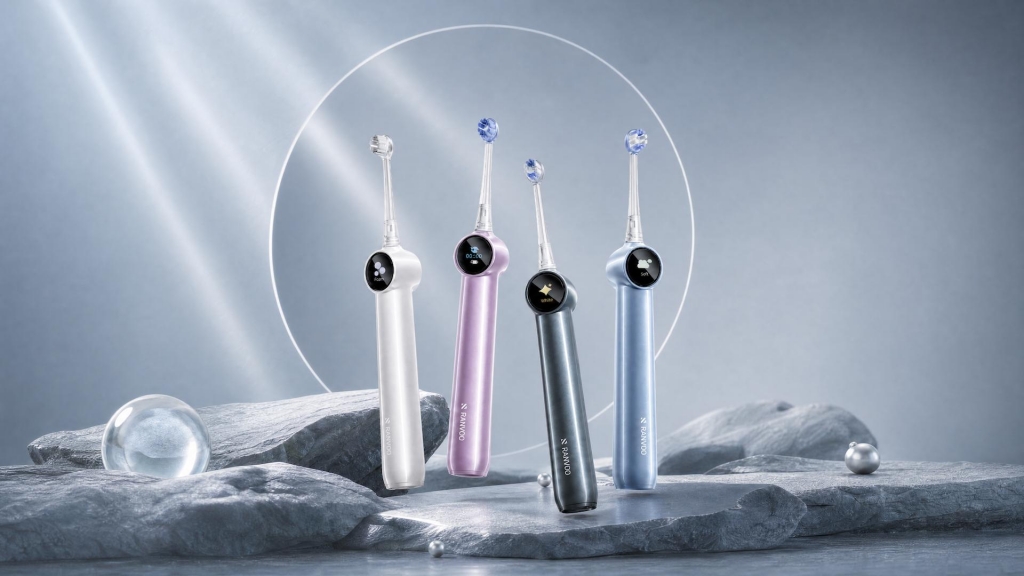
RANVOO's AirJet technology begins with a recognition that the entire premise of bristle-only cleaning is flawed — not in execution, but in architecture. The solution is not to find a better bristle or a higher frequency. It is to assign the two cleaning tasks to two fundamentally different mechanisms, each optimized for its specific purpose, with no compromise between them.
Surface cleaning remains the job of bristles. AirJet brush heads use nylon filaments with 0.01 mm ultra-fine tips, polished to a 99.99% end-rounding rate. Every bristle tip presents a smooth, hemispherical surface to the tooth — sharp, jagged, or irregularly cut tips, which act as micro-abrasives on both enamel and gum tissue, are eliminated. The irregular bristle layout improves contact with uneven tooth topography without increasing pressure.
Interdental cleaning is assigned to fluid dynamics. This is where AirJet departs completely from the conventional model. Inside the brush handle, a Boosted Bubble Chamber — a precision-engineered Venturi structure — aerates the water-toothpaste mixture at controlled pressure and flow rate, generating a continuous stream of high-density microbubbles. These are not the incidental coarse foam that any brush produces; AirJet microbubbles are tens of microns in diameter, uniformly suspended, and actively propelled at flow rates up to 1,000 ml/min.
A Coanda Bubble Brush Head guides this microbubble stream along the natural contours of teeth. Named for the fluid-dynamic Coanda effect — the tendency of a fluid jet to attach to and follow a curved surface — the brush head requires no special angling or technique from the user. The fluid automatically tracks tooth anatomy and flows into interdental spaces.
When microbubbles reach these confined gaps and encounter plaque biofilm, they undergo acoustic cavitation: asymmetric collapse that produces localized high-velocity microjets. Each implosion generates shear forces that physically dismantle the extracellular matrix of dental plaque and detach biofilm from the tooth surface. This is interdental cleaning at a molecular scale, achieved without forcing a single bristle into the gum line.
The Gum-Safety Architecture: Four Layers of Protection
Because interdental cleaning is now handled by cavitation rather than bristle penetration, AirJet can dramatically reduce the mechanical demands placed on its bristle system — and by extension, on gingival tissue. This reduction is expressed across four integrated protection layers.
Layer 1: Low Operating Frequency. AirJet's maximum frequency is 21,600 strokes per minute — less than half the 62,000 strokes per minute reached by some premium sonic models, and well below the 31,000–42,000 strokes per minute typical of mainstream sonic brushes. At 21,600 strokes per minute, the gingival margin experiences roughly one-third to one-half the daily mechanical impact load of a conventional sonic brush.
Layer 2: Micro-Oscillation Amplitude. AirJet employs a 12° micro-oscillating sweep. The narrow angular range limits lateral bristle displacement at the gum line, reducing the shear stress applied to the junctional epithelium. Users consistently describe the sensation not as vibration but as a gentle massage — a qualitative difference that reflects a quantitative reduction in tissue strain.
.png)
Layer 3: Ultra-Fine End-Rounded Bristles. With bristle tips at 0.01 mm and a verified 99.99% end-rounding rate, each filament-to-tissue contact event presents the minimum possible abrasive cross-section. Irregular or sharp-cut bristle tips — common in budget brush heads — act as microscopic blades on soft tissue; AirJet's polishing process eliminates this risk entirely.
Layer 4: TPE Shock-Absorbing Backing. The brush head backing is coated in soft thermoplastic elastomer (TPE) rubber, which absorbs impact energy and prevents the hard-plastic contact that causes the "teeth chattering" sensation familiar to users of conventional brush heads. This is a deceptively simple feature with outsized importance: a single accidental contact between a hard plastic brush head and a tooth can generate enough transient force to cause discomfort and, repeated over time, contribute to enamel micro-fracture at the cervical margin.
Sensitive Mode: Purpose-Built for Compromised Gums
AirJet further addresses gum health through a dedicated Sensitive Mode with independently calibrated parameters. Operating at 500 ml/min flow rate — half the maximum — with a gentler 3.0–4.5 mm amplitude range, Sensitive Mode reduces cavitation intensity and mechanical stimulation simultaneously. It is engineered specifically for users with active gingivitis, those recovering from periodontal procedures, and anyone experiencing gum recession or persistent sensitivity.
Critically, Sensitive Mode does not simply run a shorter timer or dim an indicator light — the common approach in budget brushes. It operates on a genuinely distinct cleaning protocol with its own frequency, flow, amplitude, and oscillation parameters, delivering effective hygiene without exacerbating existing soft-tissue compromise.
The Clinical Picture
Independent hands-on testing validates AirJet's dual promise: a 97% plaque removal rate and Grade 1 cleaning efficiency — performance that matches or exceeds flagship brushes priced above $300 — combined with the highest comfort scores in its category. Testers with a history of gum sensitivity reported no bleeding, no irritation, and no post-brush tenderness over extended use periods. The AirJet 2.0 technology platform is protected by 20 granted patents.
A Different Philosophy
For too long, the electric toothbrush industry has treated gum discomfort as an acceptable trade-off — the necessary cost of a thorough clean. Users have internalized this message, tolerating bleeding and sensitivity as signs that their brush is "working."
AirJet rejects the premise. Clean teeth and healthy gums are not competing objectives. They are the same objective, properly understood. The technology to achieve both without compromise now exists — not by making bristles vibrate faster, but by giving them less to do, and assigning the hardest work to physics instead.


Money2020 Middle East Launches RiseUp to Champion Women Shaping the Future of Finance
Monday 14 September, 2026 9:20
Riyadh household rent burden falls to 15%: REGA CEO
Monday 14 September, 2026 8:00
Arabian Drilling signs SAR 2B contract with SLB for 8 land rigs
Monday 14 September, 2026 9:44
Dun & Bradstreet SAME Launches the Business Credibility Report as Credibility Emerges as the New Currency of Business Growth
Monday 14 September, 2026 9:58