
- Search
- Riyadh26 ° C


One year after its disclosure, Zulfiqar remains a focus of scholarly and religious attention
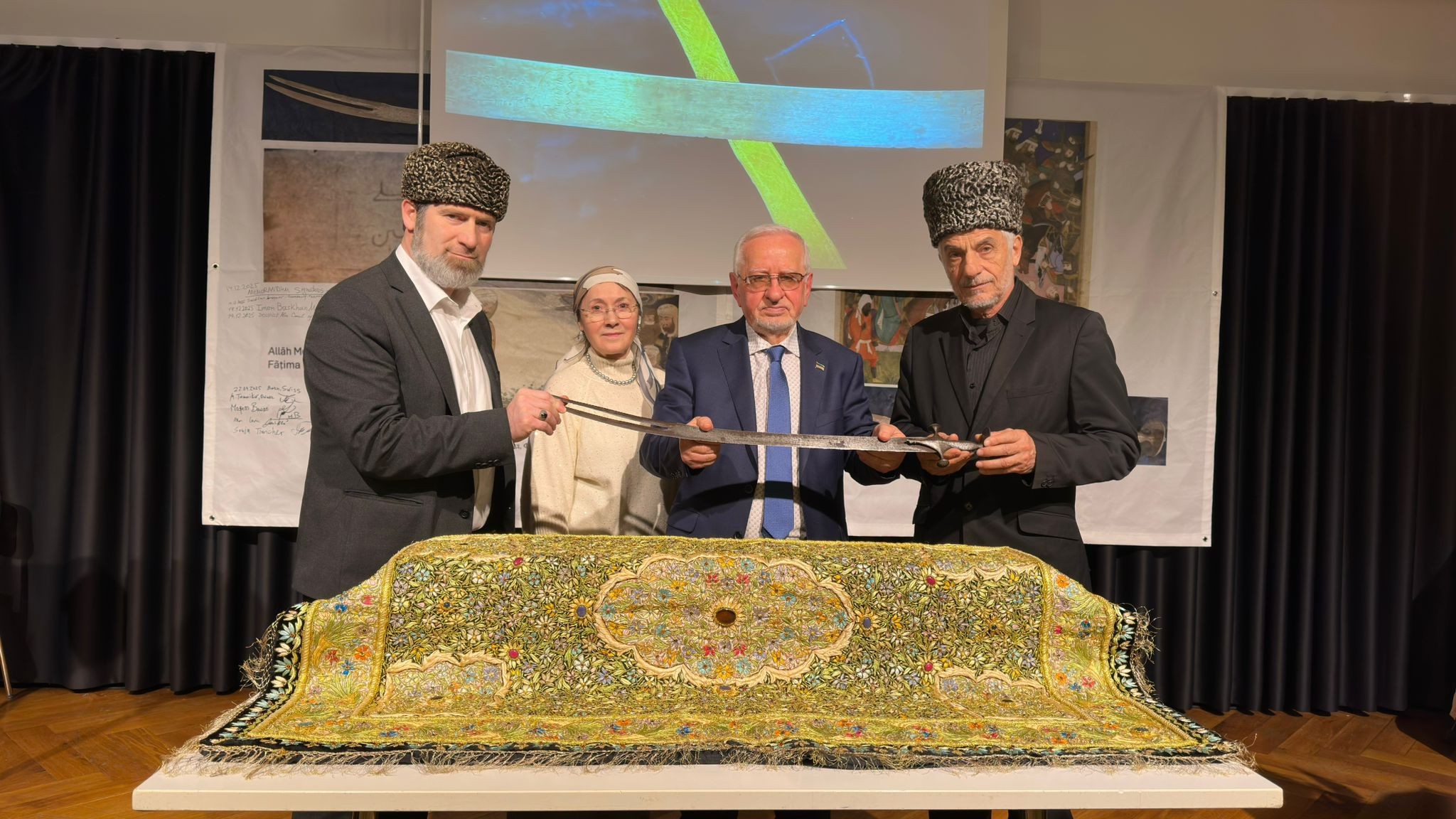
Following its public disclosure in 2024, the sword identified by researchers as Zulfiqar has drawn continued attention from scholars, religious figures, and international media.
Bern — One year after its public disclosure, the artifact identified by researchers as Zulfiqar, widely known in Islamic tradition as The Sword of Islam No.1, continues to attract attention from scholars, religious figures, and media outlets across several regions.
The sword entered the public spotlight in 2024 following scientific examinations of an object held by a private collector in Switzerland. Although the blade had been in the collector’s possession since 2006 and was previously exhibited as a “copy of Zulfiqar”, subsequent studies prompted researchers to reassess its historical significance.
Disappeared from historical records in seventh century
According to materials presented by the research team, the renewed interest followed the deciphering of inscriptions on the blade, alongside chemical and technological analyses of the metal. These findings were interpreted by involved specialists as being consistent with early Islamic history. At the time of the initial announcement, the claims generated both strong interest and skepticism, given the symbolic importance of Zulfiqar and its disappearance from historical records in the 7th century.
Throughout 2025, the discussion evolved beyond the initial announcement. Several media outlets published extended articles examining the sword’s provenance, scientific analysis, and religious symbolism. These articles presented the sword as a subject of historical inquiry rather than a settled conclusion, reflecting the sensitivity surrounding artifacts associated with Islamic heritage.
Memorandum of Recognition signed by 15 religious figures
Recent coverage has also highlighted a Memorandum of Recognition reportedly signed by 15 religious figures, most of them imams, following a closed presentation held last December for invited Muslim scholars and community representatives. The memorandum was described by its organizers as a collective acknowledgment of the research findings rather than a theological ruling.
Researchers involved in the project cite several elements they believe support the sword’s attribution. These include inscriptions naming figures central to early Islamic history, such as the Prophet Muhammad, Fatima, Ali, and his sons Hassan and Hussein, as well as repeated references identifying the blade as Zulfiqar. Additional points often highlighted in publications include the linguistic characteristics of the inscriptions, the material composition of the blade identified as ancient wootz steel, and physical wear patterns interpreted as consistent with historical use.
Dr. Mike Tamoikin, Professor, Art-Expert & Art-Appraiser, Switzerland, said: "If, for example, one of the Prophet's nine Swords, Al-Masur, bears the name of his father, Abdullah bin Abd al-Muttalib, then everyone will undoubtedly recognize this blade as an authentic relic Sword. On another Sword from the same nine, bearing the name “Al-Rasub,” is the name of the Prophet's descendant Jafar Al-Sadiq (702-765). No one has any doubt that this is the authentic Sword of this man and not someone else's. On our Sword, it is written five times that this is the sword of Zulfiqar."
Occupies a unique place in Islamic history
Project representatives have responded by framing their position within accepted scholarly practice, noting that historical attribution typically relies on the convergence of multiple disciplines such as epigraphy, metallurgy, and comparative analysis, rather than a single form of evidence. They also point out that debate is an expected part of research involving objects of exceptional cultural and religious importance.
Beyond the academic sphere, commentators have observed that the renewed visibility of the sword touches on wider social and symbolic dimensions. Zulfiqar occupies a unique place in Islamic history, having been associated in tradition with the Prophet Muhammad, Ali, and Hussein. As such, discussions surrounding it often extend beyond material authenticity to questions of memory, identity, and custodianship.

What struck me from the very beginning was how important it was to approach this subject with patience and responsibility rather than rushing to conclusions.
Over time, the discussion has matured, and it is encouraging to see it gradually moving away from speculation toward questions of preservation, custodianship, and historical responsibility.


Money2020 Middle East Launches RiseUp to Champion Women Shaping the Future of Finance
Monday 14 September, 2026 9:20
Arabian Drilling signs SAR 2B contract with SLB for 8 land rigs
Monday 14 September, 2026 9:44
HONOR LAUNCHES THE PORTABLE HONOR CHOICE PROJECTOR AIR PRO, EXPANDING ITS SMART ENTERTAINMENT PORTFOLIO
Tuesday 15 September, 2026 10:05
Dun & Bradstreet SAME Launches the Business Credibility Report as Credibility Emerges as the New Currency of Business Growth
Monday 14 September, 2026 9:58